
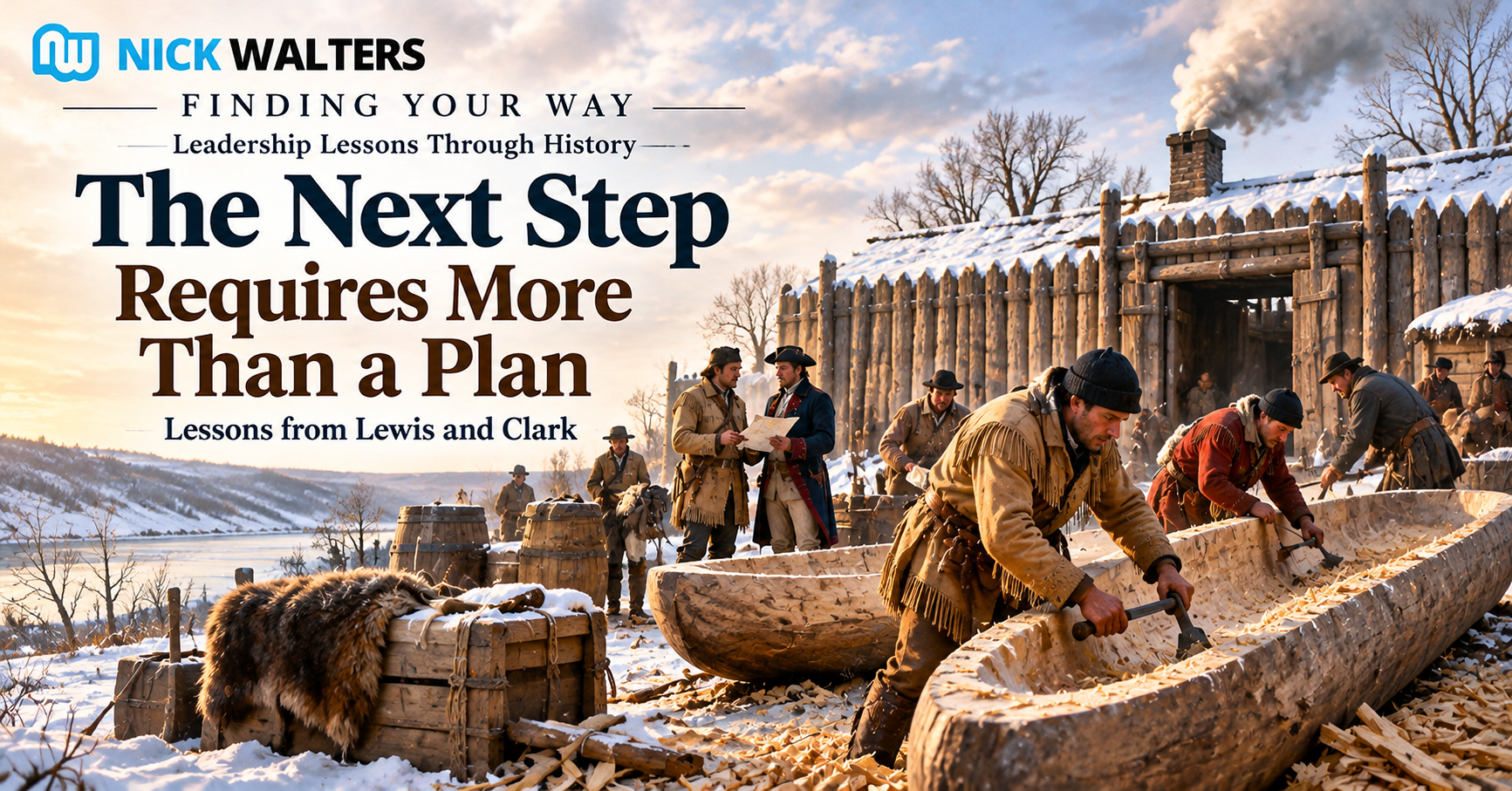
Image Citation: AI-generated historical illustration of Lewis and Clark’s expedition preparing dugout canoes and supplies at Fort Mandan during the winter of 1804–1805. Created with OpenAI’s ChatGPT for Nick Walters, Finding Your Way, 2026. Based on historical research and reference images supplied by the author.
By the spring of 1805, Meriwether Lewis and William Clark had spent nearly five months at a small wooden fort along the Missouri River near present-day Washburn, North Dakota. The winter had been bitterly cold, the river had frozen, and the men of the Corps of Discovery had endured temperatures that sometimes fell well below zero. But while the expedition waited for the ice to break, Lewis and Clark were doing something much more important than simply trying to stay warm. They were preparing for the most difficult part of their journey.
President Thomas Jefferson had sent the expedition west in 1804 to explore the recently acquired Louisiana Territory and seek a practical route to the Pacific Ocean. Lewis and Clark had already traveled more than a thousand miles up the Missouri River when they reached the villages of the Mandan and Hidatsa peoples in late October. They built their winter quarters nearby and named the settlement Fort Mandan. Although they had made considerable progress, they still had an enormous distance to cover, and much of the country ahead was unfamiliar to them.
The expedition's ultimate objective was clear enough. They wanted to reach the Pacific and return with information about the geography, natural resources, and Native peoples of the American West. But knowing where they wanted to go was one thing. Figuring out how to get there was something else entirely.
Preparing for the Journey Ahead
During the winter, Lewis and Clark began organizing nearly every aspect of the next stage of their journey. They needed food, boats, equipment, reliable information, and people capable of handling the challenges ahead. The Mandan and Hidatsa communities played an important role in these preparations, providing food through gifts and trade and sharing knowledge about the country farther west. The captains also worked to establish relationships with local leaders, including the Mandan chiefs Black Cat and Big White.
Food was a constant concern. Hunting parties traveled into the surrounding country searching for deer, elk, and buffalo, sometimes hauling frozen meat back to the fort on wooden sleds. The men also obtained corn, beans, squash, and dried meat from their Native neighbors. These supplies would become increasingly important once the expedition moved beyond the established trading communities along the Missouri.
Transportation presented another challenge. The expedition's large keelboat had served them well during the first year, but the captains planned to send it back downstream carrying their journals, scientific specimens, and other materials collected along the way. They would need smaller boats to continue upriver. Under the direction of Sergeant Patrick Gass, men began constructing six dugout canoes from cottonwood trees. Meanwhile, the existing boats had to be freed from the winter ice, repaired, and made watertight.
By March, preparations were becoming more detailed. Clark had clothing, equipment, and supplies aired in the sunshine. Corn was shelled, provisions were organized, and trade goods intended for Native peoples farther west were divided among the boats. The captains also had to determine which men would continue toward the Pacific and which would return to St. Louis with the keelboat.
None of these activities was particularly glamorous. Building canoes, repairing boats, gathering food, and sorting equipment would never receive the attention given to crossing the Rocky Mountains or reaching the Pacific Ocean. Yet without these preparations, the expedition might never have accomplished either.
Lining Up Your Dominoes
Mike Freedman and Benjamin B. Tregoe make a similar argument in their book The Art and Discipline of Strategic Leadership. They explain that organizations often spend considerable time developing strategies and describing where they want to go, but fail to give the same attention to what will actually be required to get there. A strategic vision may provide direction, but implementing that vision requires a disciplined process for identifying priorities, allocating resources, and organizing the work.
One of the central ideas in their book is what they call Strategic Master Project Planning. The idea is pretty simple. Once you've decided where you want to go, you have to figure out what it's going to take to get there. What needs to be done? What should come first? Who's going to do the work, and what resources will they need?
I like to think of it as "lining up your dominoes." Have you ever seen one of those elaborate domino displays where hundreds, sometimes thousands, of dominoes have been carefully arranged to create some amazing pattern? Someone gives the first domino a little push, and they all start falling, one after another, until the entire pattern unfolds. It's fascinating to watch, but think about all the planning and preparation that went into getting those dominoes lined up just right. If one domino is out of place, the whole thing can come to a stop.
That's the point Freedman and Tregoe are making. Some things have to happen before others can even begin. You can have a great strategy and know exactly what you want to accomplish, but unless you've taken the time to line up your dominoes, you're probably not going to get very far. The real work often takes place long before you give that first domino a push.
Think about the situation Lewis and Clark faced at Fort Mandan. Their objective had not changed during the winter. They were still going to the Pacific Ocean. But they could not simply wait for warmer weather, climb back into their boats, and expect everything to work out. They needed different transportation, additional provisions, carefully organized supplies, and a smaller party prepared for the next phase of the expedition. Each of those decisions supported the larger objective.
What I find interesting about this part of the expedition is how ordinary much of the work appears. We tend to remember Lewis and Clark for the dramatic moments of their journey, but their success also depended on months of routine preparation. The men who spent their winter making canoes and gathering supplies were contributing just as surely to the expedition's objectives as those who later crossed the mountains.
Freedman and Tregoe's argument applies to almost any organization. A business might decide to enter a new market, a nonprofit might launch an ambitious program, or a leadership team might establish a new direction for its organization. Those decisions may be sound, but they are only the beginning. Someone still has to determine what resources are available, who will do the work, what needs to happen first, and whether the organization is actually prepared to move forward.
I've seen plenty of plans that sounded impressive when they were presented. The goals were ambitious, the objectives were clearly stated, and everyone seemed enthusiastic about what was going to happen next. But sometimes the discussion ended before anyone had worked through the practical questions:
Who was responsible for getting the work done?
What would it cost, and where would the money come from?
Did we have the right people with the right skills?
What resources and equipment would we need?
What had to happen before the next step could begin?
What could go wrong, and what was our backup plan?
How would we know whether we were making progress?
These aren't necessarily the most exciting questions to ask when everyone is enthusiastic about a new idea, but they're the kinds of things you need to work through if you want to turn a good strategy into something that actually gets accomplished. It's all part of lining up your dominoes.
When Preparation Meets Opportunity
On April 7, 1805, the expedition finally left Fort Mandan. The keelboat began its journey back toward St. Louis, carrying the records and scientific collections that Lewis and Clark had assembled. At the same time, the westbound party of thirty-three people departed in six dugout canoes and two larger pirogues. Among them were Sacagawea, her infant son Jean Baptiste, her husband Toussaint Charbonneau, and York, the enslaved man who accompanied Clark throughout the expedition.
Lewis understood the significance of the moment. In his journal, he described the departure as one of the happiest moments of his life. The party was healthy, enthusiastic, and anxious to continue into the country ahead. They still faced enormous uncertainties, and their preparations could not eliminate every difficulty they would encounter. But they had done what they could with the time and resources available.
There's a lesson in that winter at Fort Mandan that leaders would do well to remember. Setting a destination is important, but preparing people to reach it is just as important. Lewis and Clark could not know everything that waited for them beyond the next bend in the Missouri River. What they could do was make sure their people, boats, equipment, and provisions were ready when it was time to leave.
And on that April morning in 1805, they were ready to go.
This post is part of Finding Your Way, where proven leadership ideas meet stories from the Lewis & Clark expedition. The full stories will be collected in my upcoming book, Beyond the Map. Sign up to be notified when it’s released.
