
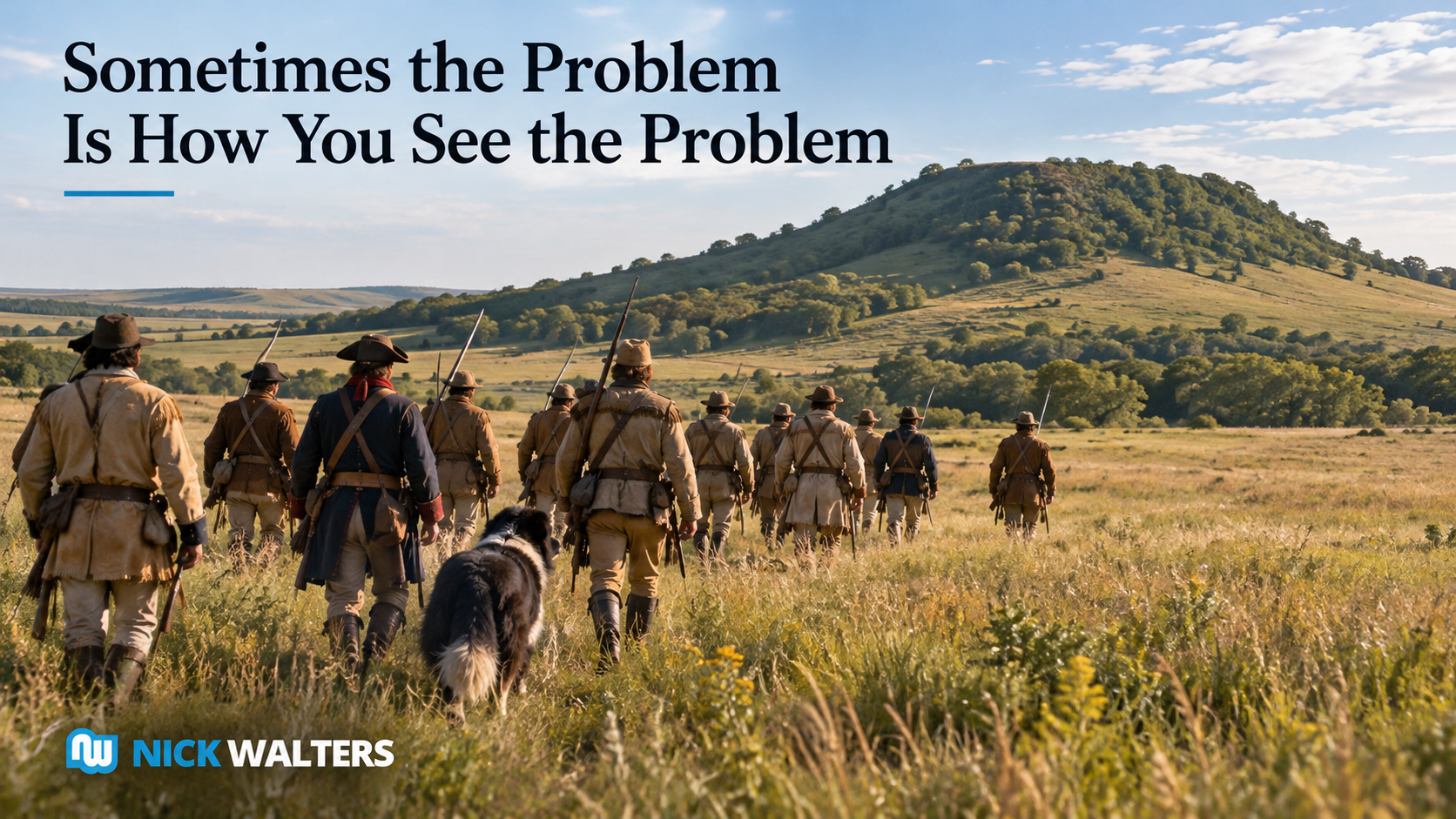
Image: AI-generated historical illustration depicting members of the Lewis and Clark Expedition approaching Spirit Mound in August 1804, accompanied by Seaman, Lewis's Newfoundland dog. Created with OpenAI for Nick Walters, 2026. Interpretive reconstruction; not a contemporary depiction of the expedition.
In August 1804, Meriwether Lewis and William Clark encountered a mystery on the Great Plains that presented an unusual challenge to their understanding of the world. They had been told about a hill inhabited by dangerous little creatures, no more than eighteen inches tall, who carried powerful arrows and were capable of killing anyone who approached their home. The warnings came from Native American traditions that described the hill as a dangerous place, one that people were wise to avoid. Lewis and Clark, however, decided that the best way to learn more about this mysterious hill was to go see it for themselves.
The expedition was only a few months into its journey across the American West. President Thomas Jefferson had commissioned Lewis to lead an exploration of the recently acquired Louisiana Territory and the lands farther west, and Clark had joined him in commanding the Corps of Discovery. Their assignment involved much more than finding a route to the Pacific Ocean. They were also expected to study the geography, plants, animals, and peoples they encountered along the way. The expedition had already learned that Native peoples possessed valuable knowledge of a country the Americans were only beginning to understand.
Near the mouth of the Vermillion River in what is now southeastern South Dakota, the explorers heard about a place known as Spirit Mound. According to traditions reported to the expedition, the hill was home to the Little People, beings with unusually large heads who were skilled with bows and arrows. The warnings were serious enough that neighboring peoples reportedly avoided the place. One account even described three Omaha men who had been killed after approaching the mound. Whatever Lewis and Clark thought about the story, it had attracted enough attention that they decided to investigate.
On August 25, the two captains, accompanied by ten men and Lewis's large Newfoundland dog named Seaman, left their boats and began walking across the prairie toward the mound. The journey proved considerably more difficult than they probably anticipated. The summer heat was oppressive, and after traveling several miles, Seaman became so exhausted that the men had to send him back to a creek they had crossed. The party continued across the open grassland, eventually reaching its destination after approximately four hours of marching.
Spirit Mound was a prominent hill rising from the surrounding prairie, offering a broad view of the country around it. The men climbed to the summit and examined the area, but they found no evidence of the dangerous little inhabitants described in the traditions. Clark observed several holes that he believed had been made by prairie wolves or badgers. The expedition also noticed large numbers of birds gathering around the hill. The expedition's published account later suggested that insects gathering around the hill attracted the birds, offering a possible natural explanation for some of the stories associated with the mound.
The captains returned to their boats without finding any Little People, although they had certainly satisfied their curiosity about what was on top of the hill. But this raises an interesting question about the difference between our examination of a place and understanding how other people perceive it. The Native traditions attached meaning to Spirit Mound that went beyond its physical appearance. Lewis and Clark approached it as explorers seeking observable evidence. They were looking at the same hill, but they were not necessarily asking the same questions about it.
Dave Gray makes an interesting point in his book Liminal Thinking. Two people can look at exactly the same situation and come away with entirely different conclusions. Each brings their own experiences and beliefs to what they're seeing, and both may be convinced they're right. Gray argues that the trouble comes when we're so certain about our own understanding that we stop considering what someone else might know that we don't.
Gray suggests that we need to be willing to question what we think we know. He calls this having a “beginner’s mind,” which simply means being open to the possibility that someone else might see something we've missed. Rather than immediately dismissing an idea because it doesn't make sense to us, he encourages us to ask questions, listen to other points of view, and see what the evidence tells us. We don't have to agree with everything someone says, but we ought to be willing to hear them out.
Think about what Lewis and Clark did at Spirit Mound. They heard the stories about the Little People, but instead of dismissing them, they made the trip across the prairie to see for themselves. Granted, some of it may have been just curiosity. What they found helped them better understand the hill itself, but it didn't necessarily explain why the Native peoples believed what they did or how those traditions had developed. The captains came away with answers to some of their questions, but there was still much about the place they didn't understand.
For leaders, the practical application reaches well beyond an unusual hill on the Dakota prairie. A disagreement among colleagues, an unexpected response from an employee, or resistance to a proposed change may reflect more than a difference of opinion. The people involved may be drawing on experiences or information that others have not considered. When someone sees things differently, a good leader ought to take the time to find out why. There may be something important they're seeing that everyone else has missed.
I like Gray’s approach, and I’ll admit that I’ve probably jumped to conclusions more times than I care to remember. I’m sure I’ve dismissed ideas that sounded about as believable as someone telling me there were Little People living on a hill nine miles away with bows and arrows ready to shoot me. But Gray makes a good point. Before we decide someone is wrong, maybe we ought to find out why they believe what they do. Ask a few questions, listen to their reasoning, and see what we might be missing. We may still disagree in the end, but at least we’ll have a better understanding of the situation before making up our minds.
Lewis and Clark never found the Little People, and you won't find any drawings of them among the expedition's records. You will, however, find descriptions of unfamiliar birds such as the Clark's nutcracker and Lewis's woodpecker. The captains had walked nine miles across the prairie to investigate a story that must have sounded pretty unbelievable to them. They didn't find what they were looking for, but at least they made the effort to find out for themselves. That's something worth remembering the next time someone comes to us with an idea that sounds a little far-fetched. We might be surprised by what we learn if we're willing to listen before making up our minds.
