
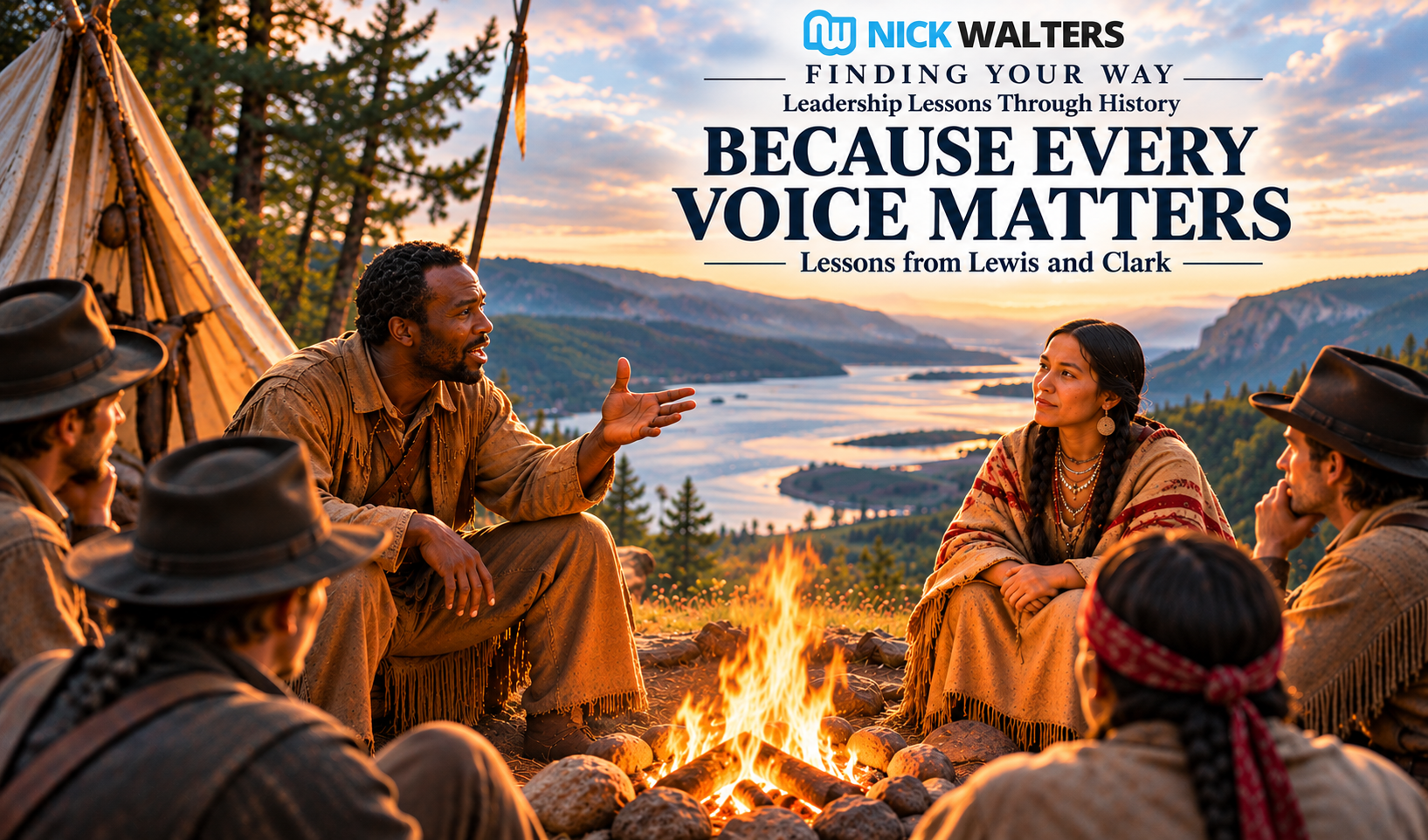
Image citation: AI-generated historical illustration created with OpenAI's ChatGPT (2026) for Nick Walters, Finding Your Way: Because Every Voice Matters. Depicts an imagined November 1805 consultation along the Columbia River, featuring York, Sacagawea, and members of the Lewis and Clark Expedition. Based on historical accounts; not a contemporary depiction.
By late November 1805, Meriwether Lewis and William Clark had finally reached the Pacific coast, but their troubles were far from over. The Corps of Discovery had traveled thousands of miles, crossed the Rocky Mountains, and navigated the dangerous waters of the Columbia River. Now winter was approaching, and the expedition needed somewhere to stay until spring.
The weather along the lower Columbia River had been miserable. Heavy rains and strong winds had repeatedly delayed their progress. Their clothing was beginning to deteriorate, and finding enough food was becoming increasingly difficult. At one point, the men had been forced to camp among driftwood logs along a narrow shoreline, where waves threatened to destroy their canoes. Even the hillside above them presented a danger as loose rocks tumbled toward their camp.
Lewis and Clark were responsible for the safety of everyone in the expedition, and the worsening conditions made their next decision especially important. Choosing where to spend the winter was no longer simply a matter of finding a comfortable campsite. They needed a location where the expedition could survive the coming months and prepare for the long journey home.
President Thomas Jefferson had sent Lewis and Clark west in 1804 to explore the Louisiana Territory and seek a practical route to the Pacific Ocean. They had accomplished much of that assignment, but they still faced a return journey of thousands of miles. Before they could begin thinking seriously about going home, they needed a secure place to spend the winter.
The question was where.
A Decision for the Entire Expedition
On November 24, 1805, Lewis and Clark did something rather unusual. Instead of simply announcing where the expedition would establish its winter quarters, they consulted the members of their party.
They could remain on the northern side of the Columbia River, cross to the southern shore, or move farther downstream toward the Pacific. Local Native Americans had indicated that game was more plentiful on the southern shore, an important consideration for a group that depended heavily on hunting. Finding protection from the winter storms was another concern.
William Clark recorded the preferences of individual members of the expedition in his journal. Among the names were two people who might surprise us: York and Sacagawea.
York was an enslaved African American man who had accompanied Clark throughout the expedition. The famous Sacagawea was the young Shoshone woman traveling with her French Canadian husband, Toussaint Charbonneau, and their infant son. She had already provided valuable assistance during the expedition's journey through the Rocky Mountains, particularly when the captains needed to establish contact with the Shoshone people. Without her assistance, it is difficult to imagine how the expedition could have made it this far.
Neither York nor Sacagawea held military rank. Yet both were included in the consultation. Clark's journal indicates that Sacagawea favored a location where wapato, an edible root, could be obtained.
Think about that for a moment. This was 1805, when women had no general right to vote in American elections and enslaved people had virtually no legal control over their own lives. Yet here, on the banks of the Columbia River, their preferences were recorded alongside those of the expedition's soldiers.
I've always found it remarkable that this early recorded consultation in the American West included a woman, a Native American, and an enslaved African American. I like to think of this as the first vote taken west of the Mississippi River.
Historians disagree about whether this was a formal vote or simply a consultation. Lewis and Clark certainly did not surrender their authority as commanders, and I don't think we should stretch this into a modern exercise in democracy. But the historical record does show that they sought opinions from people who held very different positions within the expedition.
What Makes a Team Work?
Charles Duhigg explores a similar principle in his bestselling book Smarter Faster Better. In examining why some teams perform better than others, he explains that success does not necessarily come from assembling the smartest or most talented individuals. What often matters more is how the members of a team work together.
One of the concepts Duhigg discusses is psychological safety. Simply put, people need to feel comfortable speaking up and offering their opinions without worrying that they will be embarrassed or dismissed. Leaders help create that environment by listening carefully and making sure everyone has an opportunity to contribute.
That doesn't mean every suggestion is a good one or that every decision should be made by committee. Someone still has to make the final call. But there's a difference between being responsible for a decision and assuming you're the only person capable of contributing to it.
I saw the value of this firsthand during my time as the presidentially appointed State Director of USDA Rural Development in Mississippi. We were undertaking a major effort to make our operations more efficient, which included closing a number of local offices across the state. That's another story for another day.
As we developed the plan, I made sure all 242 employees had an opportunity to offer their opinions and suggestions. One employee, who held a relatively junior position in our organizational structure, suggested a practical change in how we were approaching the reorganization. Her recommendation made a great deal of sense, and we incorporated it into our plans.
I have never forgotten that experience. Here we were making decisions that would affect an entire statewide organization, and one of the most useful suggestions came from someone who wasn't part of the leadership team. It reinforced something I've seen throughout my career: When people know their opinions are welcome, they are more willing to contribute. And when leaders take the time to listen, they sometimes discover solutions they would never have considered on their own.
The Decision That Carried Them Through Winter
Following the consultation, the expedition crossed to the southern side of the Columbia River. After further exploration of the surrounding country, the captains selected a site near present-day Astoria, Oregon, where the men constructed Fort Clatsop.
The winter was long, wet, and uncomfortable. But the fort provided the shelter the expedition needed while its members prepared for the journey home.
Duhigg makes another interesting point in Smarter Faster Better about making decisions when the outcome is uncertain. He explains that good decision-making requires us to consider what might happen next while recognizing how much we still don't know. That's precisely the situation Lewis and Clark faced on the Columbia River. They couldn't predict what the winter would bring, but they could gather information from the people around them before deciding where to establish their winter quarters.
That's an important distinction for leaders. Inviting people to offer suggestions is one thing. Creating an environment where they believe their opinions will actually be considered is something else. And sometimes that means listening to someone whose position in the organization might otherwise cause their ideas to be overlooked.
More than two centuries later, we still know that York and Sacagawea were included when the expedition considered where to spend that difficult winter. Their presence in Clark's journal reminds us that good ideas don't necessarily come from the people with the highest rank or the most impressive titles.
Lewis and Clark had the authority to make the decision, but they recognized that they didn't have all the answers. They were willing to listen to people whose experiences and perspectives were different from their own.
Leadership gives you the authority to make decisions. It doesn't give you a monopoly on good ideas.
This post is part of Finding Your Way, where proven leadership ideas meet stories from the Lewis & Clark expedition. The full stories will be collected in my upcoming book, Beyond the Map. Sign up to be notified when it’s released.
