
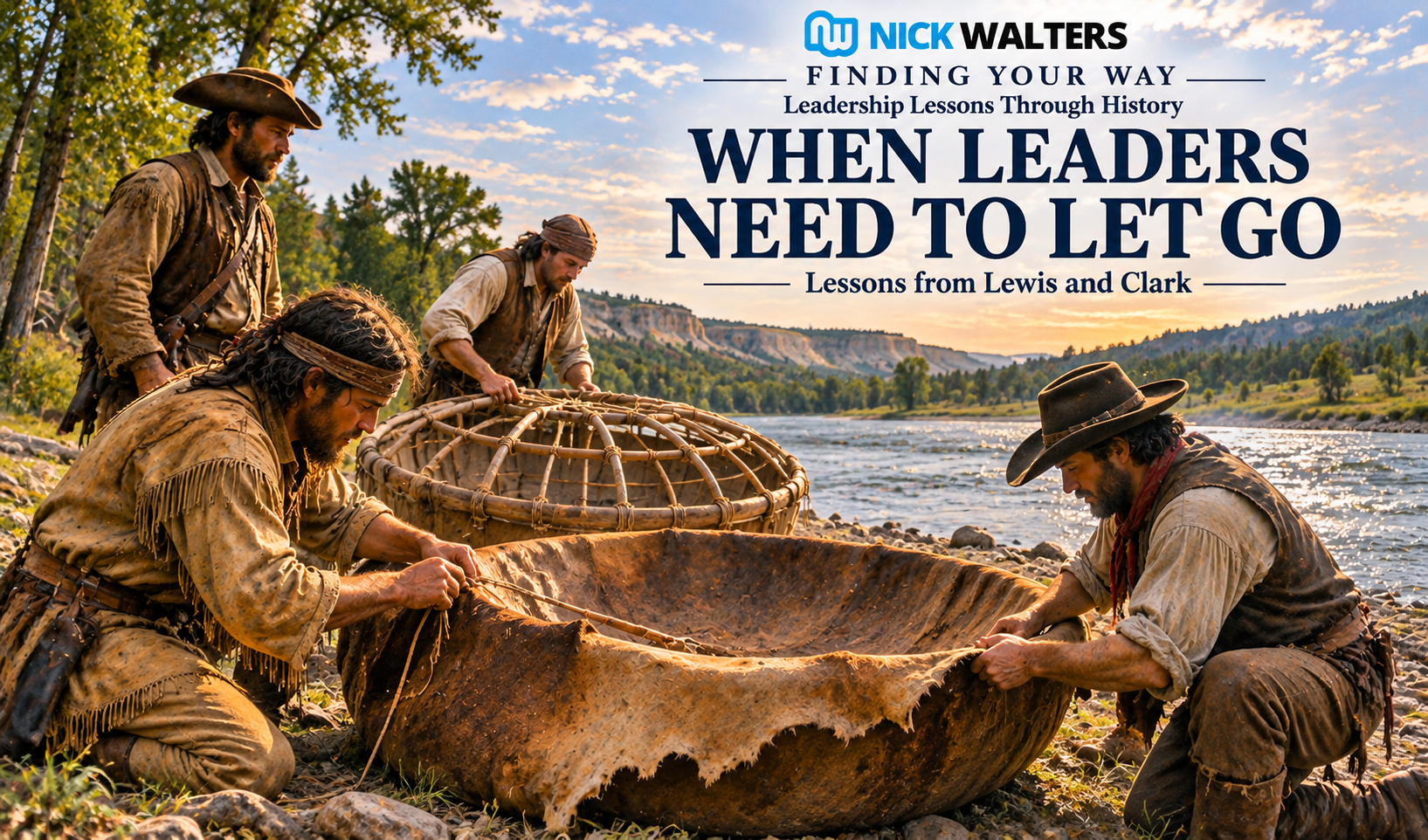
AI-generated historical illustration of Sergeant Nathaniel Pryor's party constructing bullboats along the Yellowstone River, July 1806.
When Sergeant Nathaniel Pryor and three other members of the Lewis and Clark expedition awoke on the morning of July 26, 1806, they discovered a serious problem. Their horses were gone.
The men were traveling through the Yellowstone River country near present-day Billings, Montana, carrying out an important assignment from William Clark. They were supposed to take the horses overland to the Mandan and Hidatsa villages along the Missouri River, where the animals could be used in trade and diplomatic efforts. Without the horses, their mission was essentially over.
Pryor was hundreds of miles from the nearest American settlement, and Clark was already continuing down the Yellowstone River. Texting was not an option. Pryor would have to figure it out himself.
More Than Two Years from Home
By July 1806, the Corps of Discovery was finally on its return journey home. More than two years had passed since Lewis and Clark departed the St. Louis area in May 1804. They had traveled thousands of miles, crossed the Rocky Mountains, reached the Pacific Ocean, and spent a long, wet winter at Fort Clatsop near present-day Astoria, Oregon.
President Thomas Jefferson had sent the expedition west to explore the Louisiana Territory and investigate a possible route to the Pacific. Now, with much of their assignment accomplished, Lewis and Clark were gathering additional information about the country before returning to St. Louis.
To accomplish this, they made a decision that involved considerable risk. On July 3, 1806, at a campsite known as Travelers’ Rest near present-day Lolo, Montana, Lewis and Clark divided the expedition into smaller parties. Their plan was to explore additional territory they had not seen on their westward journey. Lewis headed north toward the upper Missouri and Marias rivers, while Clark led another party south toward the Yellowstone River.
Clark later divided his own group again, assigning Sergeant Pryor a mission that required him to travel independently.
Pryor was no inexperienced soldier. He had served throughout the expedition and had earned Clark's confidence. But the assignment was difficult. The remaining horses were troublesome to manage, and Pryor recognized that his small party needed another man. Clark agreed, and Private Hugh Hall volunteered to accompany them.
On July 24, Pryor and his three companions separated from Clark’s party and headed across the prairie. Two mornings later, their horses were missing.
When the Plan Falls Apart
The horses had apparently been taken by members of the Crow Nation, whose homeland included much of the Yellowstone country. The expedition had already lost a number of horses, and now Pryor's group had lost the rest.
The original mission could no longer be completed.
Pryor and his men faced a problem familiar to anyone who has ever been responsible for carrying out someone else's plan. Their instructions had been clear, but the circumstances had changed. Following the original plan was no longer possible, and the person who had given them their assignment was nowhere nearby to provide new directions.
Rather than remain stranded or attempt an impractical overland journey, Pryor and his men returned to the Yellowstone River. There they killed bison and used the hides, together with wooden frames, to construct two small boats known as bullboats.
These simple vessels offered a way to travel downriver without the horses. The four men climbed aboard and began making their way toward Clark's party.
It was not the mission Clark had assigned them. But it was a practical response to the situation they faced.
The Responsibility Virus
Roger L. Martin explores a similar leadership problem in his book The Responsibility Virus. Martin argues that organizations frequently develop an unhealthy relationship between people who take too much responsibility and those who take too little.
Some leaders become convinced that they must make every important decision themselves. They continually intervene, correct, supervise, and take control. Meanwhile, the people working for them gradually become less willing to exercise their own judgment. Why take responsibility when the boss is going to make the decision anyway?
Before long, the leader is overwhelmed with decisions that other people are perfectly capable of making.
Clark's decision to entrust Pryor with an independent assignment provides an interesting historical example of Martin's point. Clark remained responsible for the expedition, but he could not personally direct every movement of every party. Pryor had to accept responsibility for his own mission, including decisions Clark could not anticipate.
And when the horses disappeared, Pryor had to decide what to do next.
Responsibility Doesn't Mean Controlling Everything
Both of my boys are Eagle Scouts, so I've spent a lot of time on Boy Scout camping trips over the years. One of my favorite annual activities was our cobbler cook-off. We divided the older and younger Scouts into groups, gave them recipes, and challenged them to make cobblers in Dutch ovens over the campfire. All the ingredients were laid out on a big table that served as our makeshift grocery store. There was one important rule: the adults couldn't help. We couldn't explain the recipe, open a can, or tell them how to make their cobbler.
Now, we weren't completely absent. We kept an eye on things to make sure nobody chopped off a finger or threw something into the fire just to see what might blow up. But otherwise, the boys were on their own. I watched older Scouts figure things out, make decisions, and help the younger boys learn along the way. Some cobblers turned out better than others, and a burnt cobbler wasn't much fun to eat. But even when dessert didn't turn out quite right, watching those boys learn to lead was a pretty sweet victory.
The same principle applies whether you're leading a group of Scouts or an expedition across the American West. You give people the instructions and resources they need, but you also have to give them room to make decisions. That doesn't mean abandoning your responsibility. It means recognizing that you don't have to make every decision yourself.
Clark could not have known exactly what Pryor would encounter on his journey. He could establish the assignment, select the men, and provide instructions. After that, some decisions would have to be made by Pryor himself.
The original mission failed, and the loss of the horses was a genuine setback. But Pryor and his men found a way to continue their journey. On August 8, they finally caught up with Clark, having traveled down the Yellowstone in their improvised boats.
The story reminds us that effective delegation involves more than assigning work. It requires giving people enough responsibility to respond when things don't go according to plan.
Sometimes the most important decision a leader makes is deciding which decisions someone else can make.
Recommended Reading
Roger L. Martin, The Responsibility Virus: How Control Freaks, Shrinking Violets—and the Rest of Us—Can Harness the Power of True Partnership (Basic Books, 2002). Martin examines how over-responsibility and under-responsibility reinforce one another and how leaders can develop healthier approaches to sharing responsibility.
Historical Sources
Landon Y. Jones, “Clark on the Yellowstone,” We Proceeded On, Vol. 32, No. 1 (February 2006), 24–34. Particularly pp. 30–32, describing Pryor’s assignment, the loss of the horses, and the construction of the bullboats.
Gary E. Moulton, ed., The Journals of the Lewis & Clark Expedition (University of Nebraska Press, 1983–2001), Vol. 8, July–August 1806 entries, as referenced by Jones.
This post is part of Finding Your Way, where proven leadership ideas meet stories from the Lewis & Clark expedition. The full stories will be collected in my upcoming book, Beyond the Map. Sign up to be notified when it’s released.
