
The Smartest Leader Isn't Always the Smartest Person in the Room
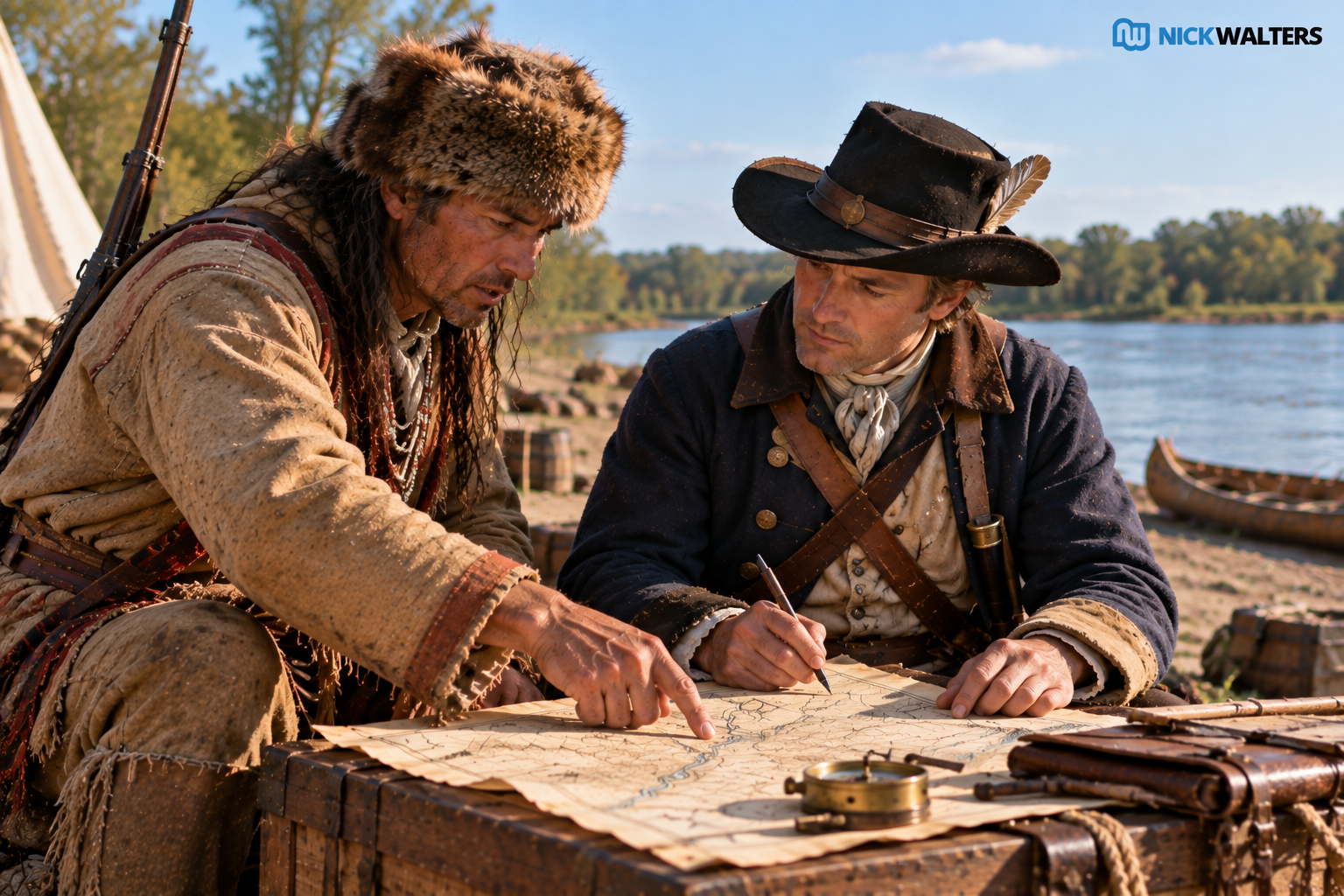
AI-generated historical illustration depicting George Drouillard sharing geographic information with William Clark during the Lewis and Clark Expedition. Created for Nick Walters, Finding Your Way, 2026. Historical interpretation; not an eyewitness depiction.
What Liz Wiseman’s Multipliers teaches about using what other people know, and two words William Clark wrote on a map
Leadership is often associated with having answers. People bring problems to the leader. The leader decides, sets direction and owns the outcome. It’s easy to slide from there into assuming the person with the most authority should also have the most knowledge.
Liz Wiseman’s Multipliers: How the Best Leaders Make Everyone Smarter challenges that assumption. Her research looks at why some leaders seem to expand the capabilities of the people around them while others shrink them. She calls the second group “Diminishers”: leaders whose reliance on their own intelligence leaves the intelligence of others unused. “Multipliers,” by contrast, recognize that capability already exists throughout an organization and create conditions that let more of it contribute.
What I took away from Wiseman is that the leadership problem usually isn’t finding smart people. It’s getting access to what those people already know. The intelligence available to an organization is rarely concentrated in one person. It’s spread among people who see different things, do different jobs and touch different parts of the world around the organization.
Here’s a story from Lewis and Clark that shows exactly what that looks like in the real world.
William Clark was the Corps of Discovery’s principal mapmaker. As the expedition traveled, he recorded distances and directions, sketched rivers and tributaries, and slowly built a picture of the country they passed through. But Clark had an obvious limitation. He could carefully map the route he traveled, and the West extended far beyond that narrow path. Rivers ran past the horizon. Mountain ranges continued in directions the Corps never went. Native people knew trails and places Clark would never personally see.
So he learned to rely on people who could see what he could not. One of them was George Drouillard.
Lewis hired Drouillard in 1803 as an interpreter for $25 a month. The son of a French-Canadian father and a Shawnee mother, he had grown up along the cultural frontier. The interpreter title proved woefully inadequate. Drouillard became one of the expedition’s most dependable hunters. He scouted, handled horses and took on assignments that carried him well away from the main party. His travels, and his ability to communicate with Native people, meant he regularly came back with information about rivers, trails and places no one in the Corps had seen.
Clark put that information to work. On one map, geographic details are noted as “informed by Drewyer,” a common spelling of his name at the time. Elsewhere, Clark used an even simpler attribution: “Drewyer Says.”
I can hardly think of a better three-word description of what Wiseman is getting at.
Clark’s accomplishment wasn’t diminished when information came from someone else. The map became more useful because it could hold knowledge beyond the mapmaker’s own experience. And Clark didn’t surrender his authority by listening. He still had to evaluate what he heard, compare accounts and decide what to record. Listening didn’t replace his judgment. It improved the information that judgment had to work with.
Every organization has its Drouillards: the people who move between departments, hear customer complaints that never reach the executive suite, or carry experience that doesn’t show up in their job titles. The leader’s job isn’t to have walked every trail. It’s to know how to reach what those people know.
Field Notes
Who are the Drouillards in your organization, the people whose value comes from connecting groups and information that would otherwise stay apart?
Think about your last big decision. Whose knowledge went into it, and whose didn’t?
Ask questions designed to discover, not just confirm. Then give credit where it’s due. Write “Drewyer Says” on the map.
Recommended Reading
If this idea interests you, I recommend reading Multipliers: How the Best Leaders Make Everyone Smarter by Liz Wiseman.
This post is part of Finding Your Way, where proven leadership ideas meet stories from the Lewis & Clark expedition. The full stories will be collected in my upcoming book, Beyond the Map. Sign up to be notified when it’s released.
