
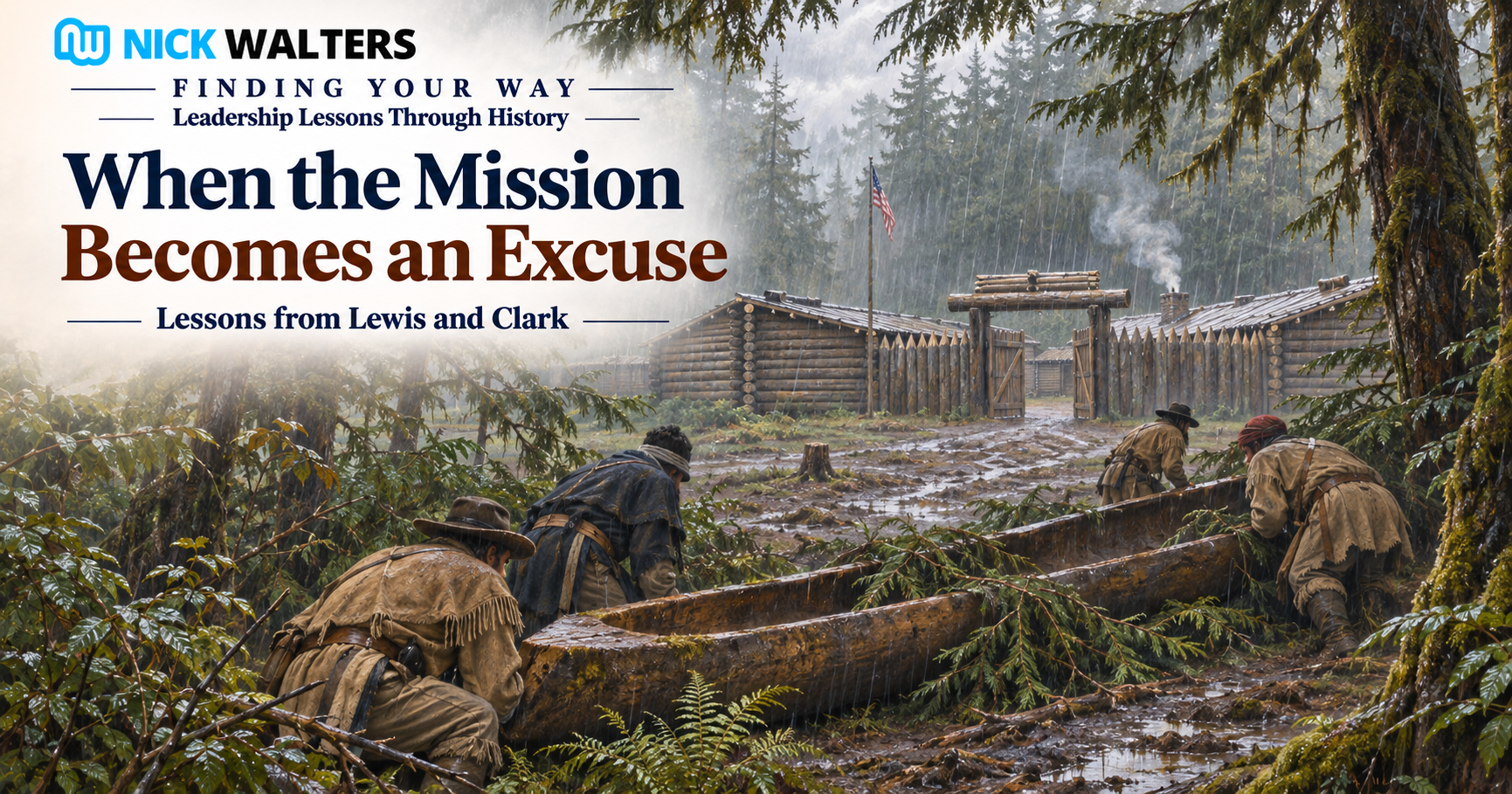
AI-generated historical illustration created for Finding Your Way by Nick Walters (2026). Depicts members of the Lewis and Clark expedition concealing a Clatsop dugout canoe near Fort Clatsop in March 1806. Interpretive illustration; not a contemporary historical image.
Sometimes leaders face difficult decisions because they don't have any good options. They have a job to do, resources are limited, and the people depending on them expect results. Under those circumstances, it's easy to convince ourselves that doing something questionable is justified if it helps us accomplish something important. Some might even consult Machiavelli’s The Prince and conclude that the ends justify the means.
But does having a good reason for doing something necessarily make it the right thing to do?
Lewis and Clark faced that question in March 1806 as they prepared to leave their winter quarters near the Pacific Ocean and begin the long journey home.
Getting Home Was Going to Be Difficult
The Corps of Discovery had spent the winter at Fort Clatsop, near the mouth of the Columbia River in present-day Oregon. After traveling thousands of miles across the continent, the expedition had finally reached the Pacific coast. Now the men needed to retrace much of their route to return to St. Louis.
They were anxious to leave. Months of almost constant rain had made life miserable, and their supplies were running low. But getting home required something they didn't have enough of: canoes.
The Columbia River would be their highway eastward, at least until they reached the point where they would have to leave their boats and cross the Rocky Mountains. Without enough canoes to carry the men, Sacagawea and her son Pomp, along with their equipment and remaining supplies, the expedition couldn't proceed as planned. And let's not forget Lewis's dog, Seaman.
Lewis and Clark had been trying to obtain additional canoes from the Clatsop and Cathlamet peoples, two Native American communities living along the lower Columbia River. These were valuable possessions, made from large trees and requiring considerable skill and labor to construct. Their owners weren't necessarily interested in selling them, particularly for what the Americans had available to trade.
On March 17, George Drouillard returned from the Cathlamet people with a canoe he had purchased in exchange for one of Lewis's uniform coats and some tobacco.
It was an expensive transaction, but the expedition still needed another canoe.
A Questionable Solution
According to Clark's journal, Drouillard and several other members of the expedition proposed taking a Clatsop canoe as compensation for six elk they claimed the Clatsops had stolen during the winter.
It was a convenient argument. If the Clatsops had taken something that belonged to the expedition, perhaps taking a canoe could be considered repayment.
But the journals don't establish that the Clatsops actually stole the elk, much less that they agreed to surrender a canoe as compensation.
The next day, March 18, four expedition members went to obtain a Clatsop canoe. Sergeant John Ordway recorded that two men brought the canoe near the fort and concealed it because Chief Coboway was visiting.
Think about that detail for a moment.
Coboway was a leader of the Clatsop people who had maintained friendly relations with the expedition throughout the winter. He and his people had traded with the Americans and visited their fort.
Now, while he was visiting, members of the expedition were hiding a canoe that belonged to his people.
Five days later, on March 23, Lewis and Clark departed Fort Clatsop and began their journey home.
They had the canoe they needed.
When Doing the Job Isn't Enough
In her book Value Shift, Harvard Business School professor emerita Lynn Sharp Paine argues that organizations must evaluate their decisions by more than whether those decisions accomplish their objectives. Leaders have ethical responsibilities that deserve consideration alongside operational and financial results.
One of the frameworks she develops is a decision-making compass built around four questions:
Purpose: Does the action serve a worthwhile objective?
Principle: Is it consistent with the standards we claim to follow?
People: Does it respect the legitimate interests of those affected?
Power: Do we have the authority to take the action?
Apply those questions to what happened at Fort Clatsop.
The purpose was certainly understandable. Lewis and Clark had a responsibility to bring the Corps of Discovery home, and another canoe would help them accomplish that.
But the other questions complicate the decision.
Was taking a canoe without its owner's permission consistent with fair dealing? What about the Clatsop people, whose property was being taken? And did the Americans have the authority to declare that a disputed loss of elk entitled them to someone else's canoe?
Paine's framework reminds us that a worthwhile objective doesn't automatically answer those other questions.
The captains were capable leaders who accomplished an extraordinary mission under difficult circumstances. But that doesn't mean every decision they made was a good one.
The Danger of Making Exceptions
This is where the story becomes particularly useful for leaders today.
Most of us won't find ourselves trying to obtain a canoe on the Columbia River. But we may face circumstances where achieving an important objective seems to require bending a rule, ignoring a commitment, or treating someone unfairly.
A manager might justify withholding information because a project is behind schedule. A nonprofit leader might overlook a questionable expense because the money supports a worthwhile cause. Someone in government might be tempted to bypass established procedures because the outcome would benefit the public.
The reasoning usually begins with the importance of the mission rather than a deliberate intention to do something wrong.
And sometimes that's what makes these decisions so dangerous. We become so focused on accomplishing something good that we stop examining the means we're using to accomplish it.
What Are You Willing to Justify?
Lewis and Clark successfully returned to St. Louis in September 1806. Their expedition produced an extraordinary record of the American West, including its geography, wildlife, and Native peoples.
But the fact that they accomplished their mission doesn't excuse every decision they made along the way.
Paine's argument gives us a useful way to evaluate our own leadership. Success isn't measured only by whether we achieve the objective. We also have to consider how we achieved it and how our decisions affected other people.
The next time you're facing a difficult decision, perhaps the most important question isn't whether the action will help you accomplish your mission.
It's whether you would still consider it the right thing to do if the mission weren't so important.
Recommended Reading
Lynn Sharp Paine, Value Shift: Why Companies Must Merge Social and Financial Imperatives to Achieve Superior Performance (McGraw-Hill, 2002). Examines how organizations can integrate ethical responsibilities with performance objectives, including a four-part framework for evaluating difficult decisions.
Historical Sources
Gary E. Moulton, ed., The Journals of the Lewis and Clark Expedition (University of Nebraska–Lincoln, online edition). Journal entries for March 17, 18, and 23, 1806.
John Ordway, journal entry for March 18, 1806, in The Journals of the Lewis and Clark Expedition, edited by Gary E. Moulton.
This post is part of Finding Your Way, where proven leadership ideas meet stories from the Lewis & Clark expedition. The full stories will be collected in my upcoming book, Beyond the Map. Sign up to be notified when it’s released.
