
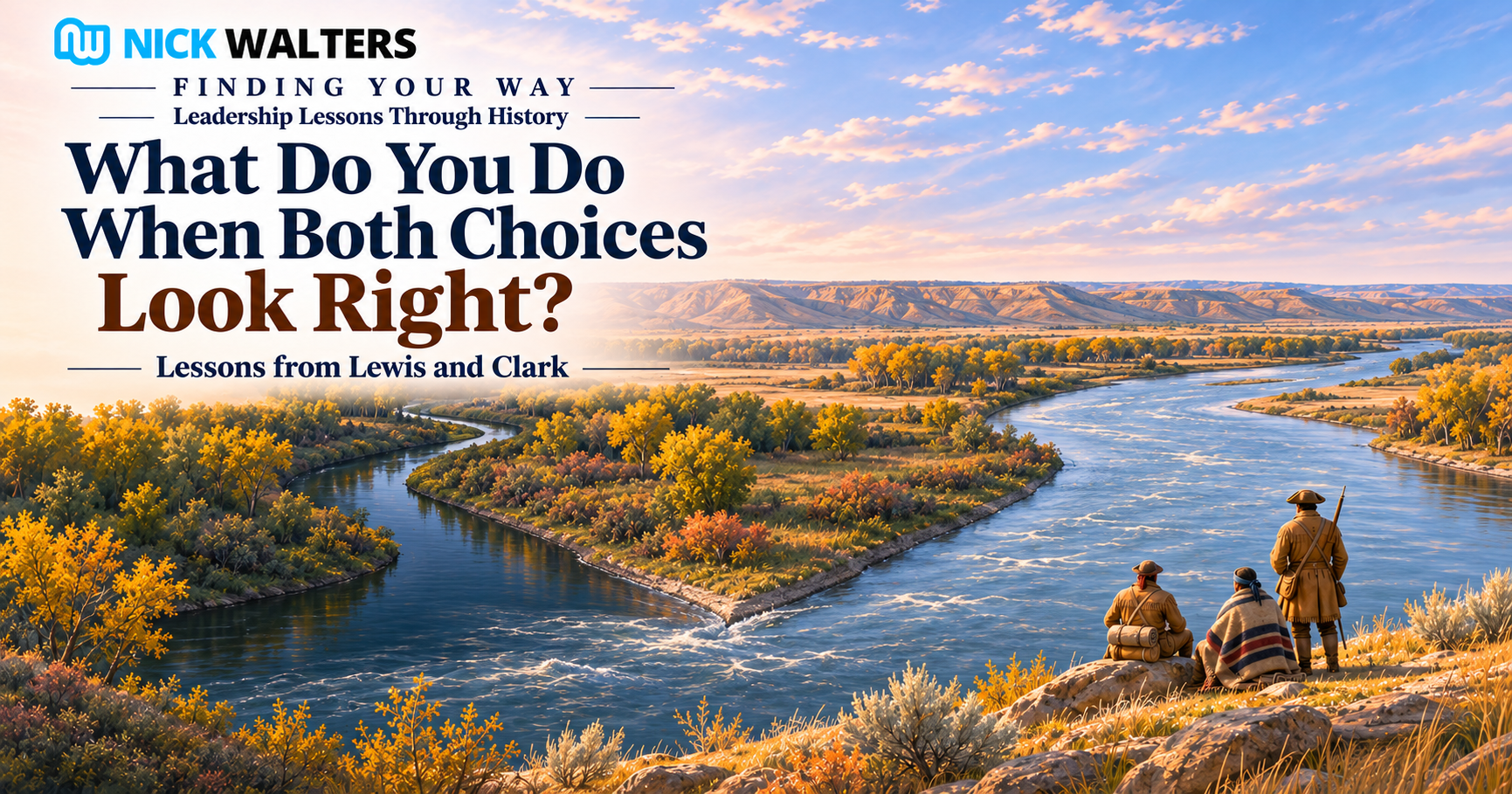
AI-assisted historical illustration created for Finding Your Way by Nick Walters (2026). Inspired by a reference photograph of the Missouri–Marias river confluence by QT Luong, © 2020, terragalleria.com.
Sometimes the hardest decisions aren't between a good choice and a bad one. They're between two choices that both seem reasonable. You can have good people looking at the same information and reaching very different conclusions.
That's when leadership becomes difficult. You have to decide which direction to take, knowing that the people who disagree with you may have perfectly good reasons for doing so. And if you make the wrong choice, the consequences can be significant.
Lewis and Clark faced exactly that kind of decision in June 1805, when their expedition reached an unexpected fork in the Missouri River.
Two Rivers, Two Different Opinions
For more than a year, the Corps of Discovery had been traveling west under the direction of President Thomas Jefferson. Their assignment included exploring the vast territory acquired through the Louisiana Purchase and searching for a practical water route to the Pacific Ocean.
On June 2, 1805, Lewis and Clark faced a decision that could send their expedition miles in the wrong direction and cost them valuable time. After months of struggling upstream against the Missouri River's powerful current, they reached a point in present-day Montana where two large rivers came together. President Jefferson had instructed them to follow the Missouri to its headwaters and search for a route to the Pacific Ocean. But standing at the junction of these two rivers, they faced a problem they hadn't anticipated. Which one was the Missouri?
Most of the men believed the northern branch was the Missouri because it looked like the same river they had been traveling on for months. As far as they were concerned, there was no reason to think they should change course.
Lewis and Clark believed otherwise. They thought the southern branch was the Missouri and would eventually lead them toward the mountains.
Both sides had reasons for their conclusions. The men trusted what they could see, while the captains compared the rivers with geographical information they had gathered from the Mandan and Hidatsa people during the winter they had just spent at Fort Mandan in present-day North Dakota. These nations knew about the Great Falls farther upriver.
The problem wasn't a lack of opinions. It was determining which opinion was correct.
When You Need More Than an Opinion
Lewis and Clark didn't immediately order their men up the southern river. They began gathering more information.
They examined the width, depth, and current of both waterways. They sent parties upstream to investigate and climbed the surrounding heights to study the terrain. They also compared their observations with descriptions of the country they expected to encounter.
Their initial investigations strengthened the captains' belief that the southern branch was the Missouri, but the evidence wasn't conclusive. Most of the men remained convinced that the northern river was the correct route.
Lewis and Clark decided they needed to investigate further, and this time they would go themselves. On June 4, Clark led a small party up the southern branch while Lewis took another group up the northern branch. Lewis would name it Maria's River for his cousin Maria Wood back home in Virginia. Over time, the possessive apostrophe was dropped, and it's now called the Marias River.
They spent the next several days following the rivers and looking for evidence that might settle the question. By June 8, both captains had returned to camp after traveling considerable distances upstream. Their findings reinforced their belief that the southern river was the Missouri, but most of the men still disagreed.
Even after several days of investigation, the captains had not convinced their own expedition that they were choosing the correct route.
In their book Super Thinking: The Big Book of Mental Models, Gabriel Weinberg and Lauren McCann explain how mental models can help us make better decisions. One of the concepts they discuss is called de-risking. Put simply, it means testing your assumptions against real-world evidence before making a decision that could have significant consequences.
But there's another problem we have to watch for when making decisions. Weinberg and McCann discuss something called confirmation bias, which is our tendency to give more weight to information that supports what we already believe. Once we've decided we're right, it's easy to find more reasons to agree with ourselves. And the longer we've held an opinion, the harder it can become to question it.
One way to guard against that tendency is to deliberately consider the opposing argument, an approach the authors describe as playing devil's advocate. Rather than simply asking why your position is right, ask what the other side might be seeing that you've overlooked.
That's what makes this Marias River decision such a useful leadership story. Lewis and Clark believed the southern river was the Missouri, and they had good reasons for thinking so. But they didn't dismiss the men who disagreed with them. They investigated both rivers, even though that meant spending several additional days before proceeding.
They weren't simply trying to convince their men that they were right. They were trying to determine whether they actually were right.
Finding the Evidence That Matters
But the captains felt this was such an important decision that it warranted more evidence. So, on June 11, Lewis struck out along the southern branch, looking for the Great Falls to settle the question once and for all. Two days later, he found them.
The captains had been right.
But the more important leadership lesson isn't simply that Lewis and Clark made the correct decision. It's how they approached a situation where the available evidence was incomplete and reasonable people disagreed.
They didn't eliminate every uncertainty about the journey ahead. In fact, they would soon discover that some of their expectations about the geography of the West were badly mistaken, as we've explored in other blog posts. But they had reduced the uncertainty surrounding this immediate decision enough to move forward.
What About Your Next Difficult Decision?
Most leaders won't find themselves choosing between two unexplored rivers, but the underlying problem is familiar.
You might be deciding whether to expand a business or reorganize an operation. Your advisers may disagree, and each side may present a reasonable argument.
The temptation is to keep discussing the alternatives until everyone agrees or until the leader simply makes a decision. But perhaps the more useful question is whether there's a way to test the assumptions behind those competing recommendations.
Without naming names or places, and to protect the innocent and keep my email from blowing up, I remember a time when I was chairing a three-person subcommittee of a nonprofit board. We had some pretty significant purchasing decisions to make, and the paid staff had a different recommendation from the one another committee member and I favored. The third committee member wasn't paying much attention, so the disagreement was essentially between the board members and the staff.
We spent more time discussing the options and investigating the details. Once we started comparing apples to apples, it became clear that the staff had been right all along.
Nobody was mad. There were no high fives or rounds of "I told you so," at least to my face. We were all comfortable that we had made the best decision for the people we were trying to help.
Of course, leaders don't always have the luxury of spending several days investigating a decision like Lewis and Clark did. Sometimes you have to make the best decision you can with the information you have. But when you do have time to investigate further, it makes sense to use it.
Lewis and Clark turned out to be right about the Missouri River. In my case, the staff was right and I was wrong. But both decisions benefited from taking the time to investigate rather than simply insisting on a particular outcome.
The next time you find yourself disagreeing with people whose judgment you respect, perhaps the best question isn't how you can convince them you're right. It's whether you've done enough to make sure you are.
Recommended Reading
Gabriel Weinberg and Lauren McCann, Super Thinking: The Big Book of Mental Models (Portfolio, 2019). Explores mental models that help people make better decisions, including de-risking, confirmation bias, and the value of considering opposing viewpoints.
Historical Source
John Logan Allen, “The Summer of Decision: Lewis and Clark in Montana, 1805,” We Proceeded On, Vol. 2, No. 3 (Fall 1976), pp. 8–11.
This post is part of Finding Your Way, where proven leadership ideas meet stories from the Lewis & Clark expedition. The full stories will be collected in my upcoming book, Beyond the Map. Sign up to be notified when it’s released.
