
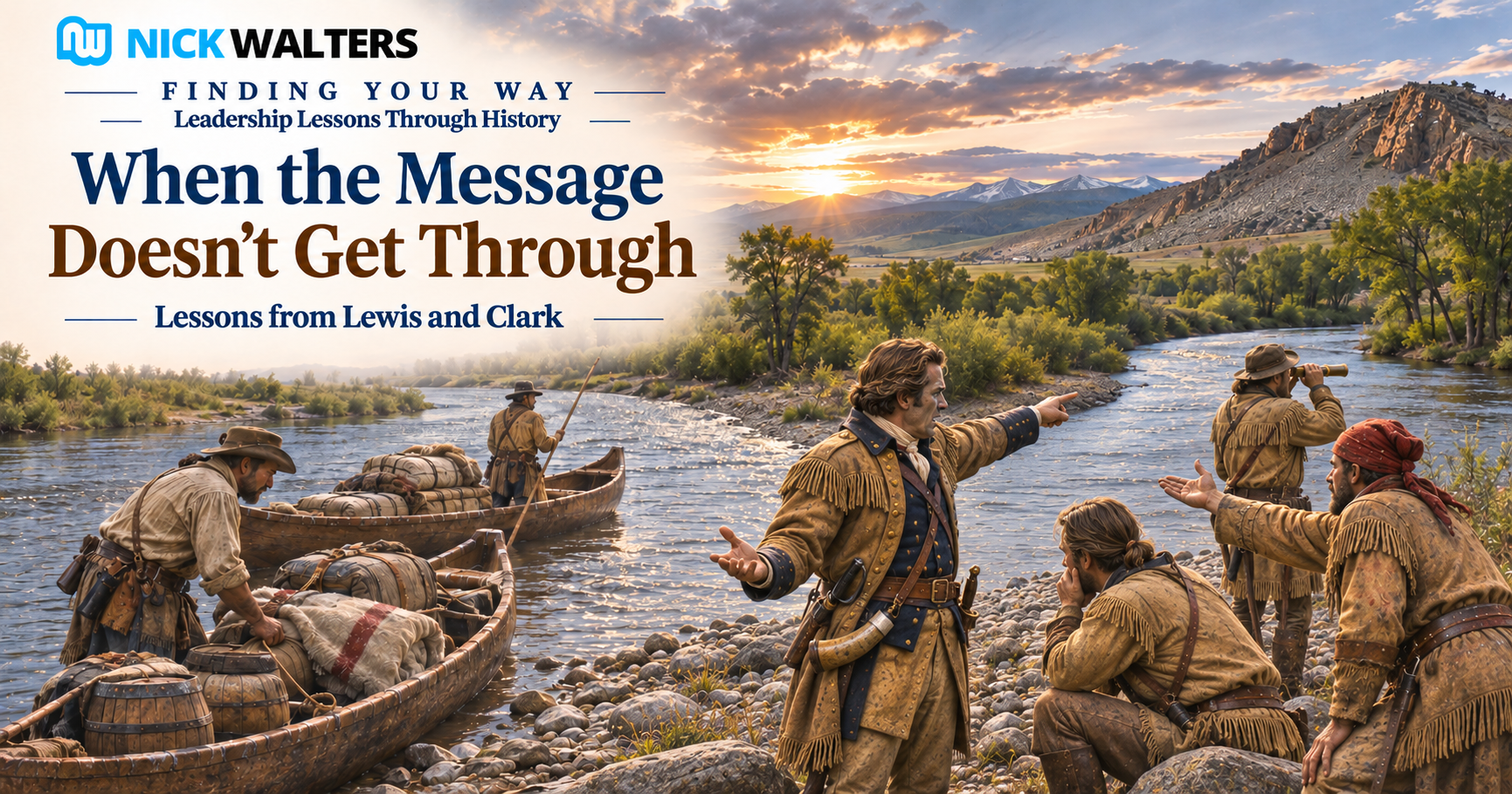
Historical illustration of William Clark and members of the Lewis and Clark expedition discussing which branch of a Montana river to follow in August 1805, with loaded dugout canoes nearby.
Have you ever spent considerable time preparing an important message, only to discover that the people you wanted to reach didn't understand what you were trying to tell them? Perhaps it was an announcement to employees, a new marketing campaign, or an explanation of a change in company policy. Everything seemed perfectly clear when you wrote it, but the response wasn't what you expected.
But there's an important difference between delivering a message and communicating effectively.
In his book Building a StoryBrand, Donald Miller argues that many businesses have a communication problem they don't recognize. They spend so much time talking about themselves that they overlook what customers really want to know: how can this business help me solve my problem?
Miller's central argument is that clarity is essential to effective communication. And sometimes the most important part of a message isn't what the sender wants to say, but what the recipient needs to know.
A Message Lost Along the Missouri
Meriwether Lewis and William Clark encountered a particularly frustrating communication problem in August 1805, as their expedition approached the Rocky Mountains on its journey toward the Pacific Ocean.
The Corps of Discovery was traveling up the Missouri River system in present-day Montana. After reaching the river's headwaters, where three rivers converged, the captains followed the Jefferson River west toward the Rocky Mountains. Progress was slow because the men had to move heavily loaded canoes against the current. They were also searching for the Shoshone people, hoping to obtain horses for the difficult mountain crossing ahead.
To make better progress, Lewis and Clark sometimes separated. One captain would scout ahead on foot while the other remained with the boats. They communicated by leaving written messages at prominent locations along the river.
On August 4, Lewis reached a junction where two rivers came together. He determined that the expedition should continue up the left branch, today's Beaverhead River, rather than the right branch, today's Big Hole River. Before moving on, he left a written message directing Clark to take the correct route.
But when Clark reached the junction, the message was nowhere to be found.
With no instructions from Lewis, Clark chose the right branch and began moving his boats up the Big Hole River. After struggling against the current for nine miles, he encountered one of Lewis's scouts, who informed him that he was traveling in the wrong direction.
The men turned around, but their problems weren't over. As they struggled to move the heavily loaded canoes back down the river, one of the boats overturned, spilling its cargo into the water. The expedition had to stop and dry its soaked supplies before continuing. It was a miserable and frustrating setback. They had already wasted considerable time and energy fighting their way up the wrong river, and now they faced additional work simply to get back to where they should have been in the first place.
Lewis and Clark later concluded that a beaver had chewed through the pole holding the message and carried it away. Lewis had left instructions. Clark had never received them. And the expedition paid the price.
Making the Message Clear
Donald Miller's Building a StoryBrand addresses a different kind of communication failure, but one that can be just as costly for a modern business.
Miller argues that businesses often make themselves the central character in their communications. They want customers to know how long they've been in business, how much experience they have, and why their products are better than those of their competitors.
Those things may be important, but Miller suggests that customers are primarily interested in solving their own problems.
His StoryBrand framework reverses the usual approach. Instead of positioning the business as the hero, Miller places the customer in that role. The business becomes the guide, helping customers understand their problem, recognize a solution, and determine what action to take next.
That distinction can fundamentally change how an organization communicates.
Consider a company developing a new website. It might fill its home page with descriptions of its history, staff qualifications, and accomplishments. But what if visitors can't quickly determine what the company actually does, how it can help them, or what they're supposed to do next?
The information may be accurate, but the message isn't accomplishing its purpose.
While Miller focuses primarily on business communication, the same principles can apply to a church, a university, a nonprofit organization, or even conversations around your own dinner table. Regardless of the audience, communicating effectively means making sure people understand what you're trying to tell them.
Communication From the Other Side
The experience of Lewis and Clark illustrates something worth remembering about Miller's argument.
Lewis knew exactly which river Clark needed to take. He had identified the correct route and prepared instructions for his fellow captain. From Lewis's perspective, the communication had been handled.
But Clark's experience was entirely different. He arrived at the junction without the information necessary to make the right decision.
The problem wasn't that Lewis's instructions were too complicated or difficult to understand. They simply never reached their intended audience.
Miller's point is that even when people receive our message, that doesn't necessarily mean they understand what we're trying to tell them. Sometimes we're so focused on what we want to say that we don't give enough thought to how the people on the receiving end will understand it.
As I was getting into high school, I became increasingly interested in politics. I eventually double-majored in history and political science in college, so I suppose that interest never really went away.
One of the stories my high school government teacher pointed out to me involved Senator Ted Kennedy and his unsuccessful campaign for the Democratic presidential nomination in 1980. I was only in the eighth grade when CBS correspondent Roger Mudd interviewed Kennedy in November 1979, and following television news interviews wasn't exactly high on my list of interests at the time.
Mudd asked Kennedy a pretty straightforward question: Why did he want to be president?
You would think someone preparing to run for the highest office in the country would have a good answer ready. But Kennedy struggled to explain himself. His answer went on for some time without ever really getting to the point.
The interview became an embarrassing moment for Kennedy's campaign, and I can still remember my government teacher using it as an example of how important it is to communicate clearly.
That's really what Miller is getting at. You can have all the experience in the world and believe strongly in what you're doing, but if you can't explain it in a way people understand, you're going to have a hard time convincing them to follow you.
What Does Your Audience Need to Know?
Before preparing your next important message, Miller's approach suggests thinking about it from the perspective of the people you're trying to reach. Ask yourself:
What problem are they trying to solve?
What information do they need to make a decision?
What do I want them to do after receiving my message?
These questions may seem obvious, but they're easy to overlook when we're concentrating on what we want to say.
Lewis and Clark had a system for communicating while they were separated. Most of the time, it worked. On this occasion, it didn't (beaver or no beaver).
Modern businesses have far more sophisticated communication tools than a handwritten note attached to a pole. But having better tools doesn't necessarily mean we're communicating more effectively.
Whether you're trying to reach a customer, explain a new policy to employees, or simply get your point across, perhaps the most important question isn't whether you've said what you wanted to say. It's whether the people on the receiving end understand what you meant.
Recommended Reading
Donald Miller, Building a StoryBrand: Clarify Your Message So Customers Will Listen (HarperCollins Leadership, 2017). Introduces a seven-part framework for helping businesses communicate clearly by focusing on customers' problems and showing them a path toward a solution.
Historical Sources
Arlen J. Large, “The Leapfrogging Captains,” We Proceeded On, Vol. 8, No. 3 (July 1982), pp. 4–5.
Roger Mudd, CBS Reports: Teddy, CBS News, November 4, 1979.
This post is part of Finding Your Way, where proven leadership ideas meet stories from the Lewis & Clark expedition. The full stories will be collected in my upcoming book, Beyond the Map. Sign up to be notified when it’s released.
