
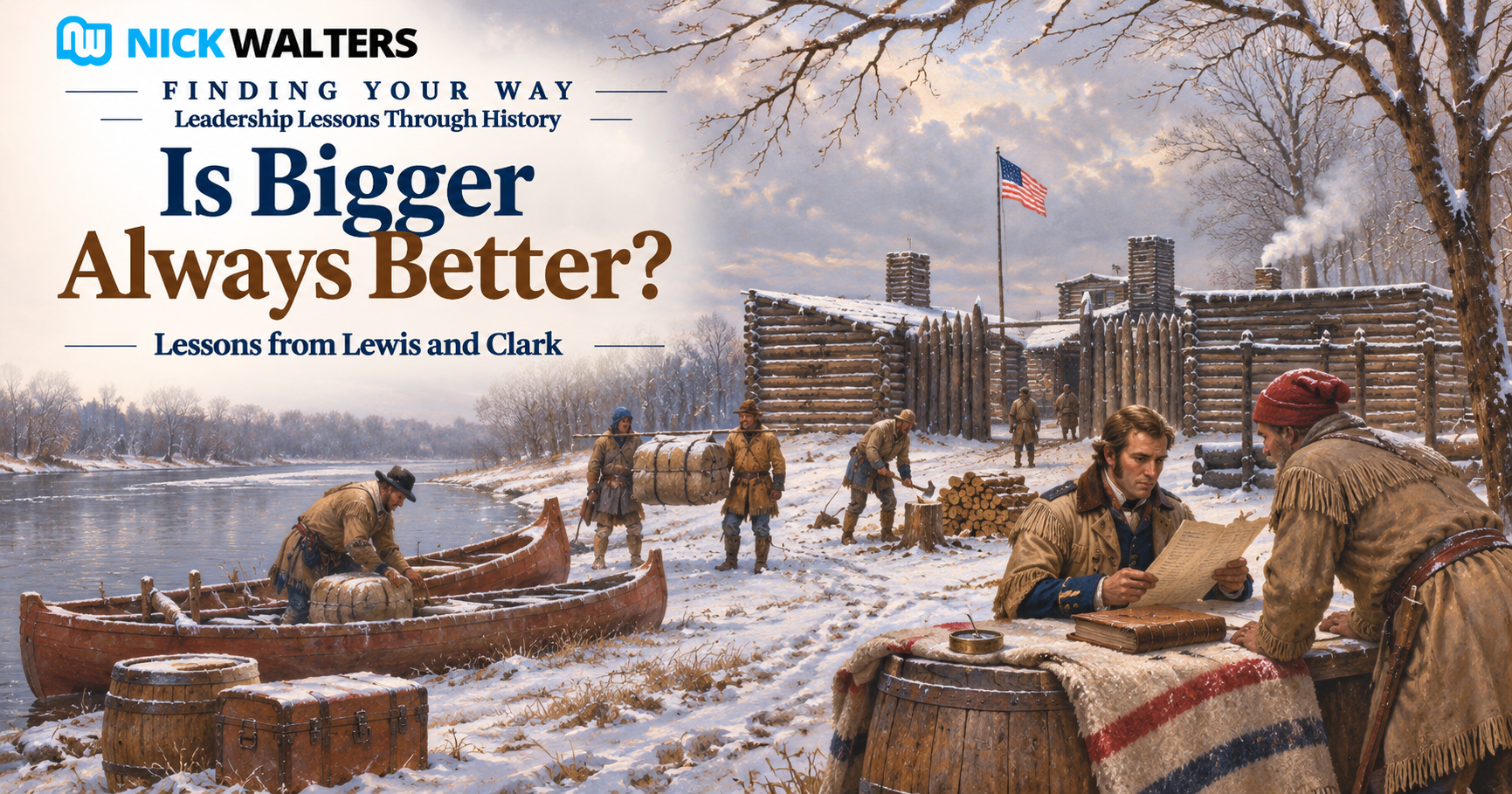
AI-generated historical illustration for Finding Your Way, created for Nick Walters (2026). Depicts an imagined scene of William Clark and expedition members preparing at Camp Dubois during the winter of 1803–1804. Based on historical research and supplied visual references; not a depiction of a documented meeting.
How many people does it take to accomplish an important mission? If you're planning a new business or reorganizing an existing operation, it's a question worth asking. Too few people, and you may not have the resources to get the job done. Too many, and you can create additional costs and complications that make the work more difficult.
But how do you know when you've got the right number?
William Clark was wrestling with that question in January 1804 as he prepared for the Lewis and Clark expedition. At Camp Dubois, named for a nearby river and located near the junction of the Missouri and Mississippi rivers, he considered different possibilities for the number of men they would need. Twenty-five? Thirty? Thirty-seven? Perhaps even fifty?
The numbers were considerably larger than President Thomas Jefferson had originally envisioned.
A Mission That Kept Growing
When Jefferson proposed an expedition across the western portion of North America in 1803, he thought the assignment could be accomplished by an intelligent officer accompanied by ten or twelve carefully selected men.
The mission was ambitious. Jefferson wanted the explorers to investigate the geography of the West, establish relationships with Native American nations, and look for a practical route to the Pacific Ocean. Much of the country they would travel through was unfamiliar to American officials, and nobody knew exactly what challenges awaited them.
Lewis initially acquired fifteen rifles and enough equipment for approximately fifteen men. But as preparations continued, the original plan became increasingly difficult to follow.
Moving a heavily loaded keelboat upstream against the Missouri River's current required considerable manpower. There were also concerns about how the expedition might be received by Native nations along the route, particularly those with substantial military strength.
By the time Lewis and Clark left Camp Dubois in May 1804, the expedition numbered approximately forty-five people.
That was a remarkable increase from Jefferson's original proposal. But did having more people necessarily make the expedition better prepared?
The Difference Between Bigger and Better
In his book Company of One, Paul Jarvis challenges the assumption that organizational growth is always a sign of success. He argues that businesses frequently treat expansion as the natural response to almost every challenge. More customers require more employees. More employees require additional management. Before long, the organization is spending a growing share of its time and resources simply supporting its own size.
Jarvis isn't suggesting that every business should consist of one person. His argument is that growth should be questioned rather than automatically pursued.
He identifies simplicity as one of the characteristics of organizations that deliberately resist unnecessary expansion. Every additional employee or new layer of management can introduce costs that weren't part of the original plan. Those costs may be justified, but leaders ought to understand what they're getting in return.
One of Jarvis's most useful distinctions is between making an organization bigger and making it better. The two aren't necessarily the same. A business might increase revenue without increasing its workforce. It might serve customers more effectively by improving its processes rather than opening another office.
That raises a question worth considering before making the next hire or launching another expansion: What problem are we actually trying to solve, and is getting bigger the best way to solve it?
Lewis and Clark faced a similar question, although their circumstances were considerably different from those of a modern business.
They needed more manpower to move their boats and protect the expedition. But they also knew that every additional person would require food and equipment. More people could help accomplish the mission, but they also placed greater demands on the expedition's limited resources.
And not everyone was needed for the entire journey.
Growing Without Making Everything Permanent
One of the more interesting decisions the captains made was to organize their personnel according to how long they would be needed.
The permanent party would travel all the way to the Pacific. Other soldiers and civilian boatmen would accompany the expedition only during its earlier stages, helping move supplies and providing additional manpower when the workload was particularly demanding.
This arrangement resembles another argument Jarvis makes in Company of One. Increasing an organization's capacity doesn't always require expanding its permanent structure. Sometimes the better approach is to improve the way work gets done or bring in additional help for a particular assignment.
That doesn't mean Lewis and Clark were practicing modern business management. Their decisions were driven by the practical difficulties of moving a military expedition through unfamiliar territory. But the distinction between permanent resources and temporary assistance is one today's leaders can recognize.
And the captains couldn't always predict how long they would need those extra resources.
In September 1804, the heavily loaded keelboat was having difficulty navigating the Missouri River's sandbars. The explorers decided to retain their supporting boats and crews longer than originally planned. The additional manpower would remain with the expedition through the winter.
By April 1805, circumstances had changed again. After spending several months among the Mandan and Hidatsa villages in present-day North Dakota, the expedition was ready to continue west. The keelboat returned downriver carrying records and scientific specimens, along with personnel who would not accompany the expedition to the Pacific.
Lewis and Clark continued with thirty-three people, including Sacagawea and her infant son, Jean Baptiste.
They had increased the expedition's size when the work required it, then reduced the group when the nature of the mission changed. And once they reached the more difficult western portion of the journey, the captains became reluctant to send anyone else home.
Knowing When Enough Is Enough
Jarvis encourages business leaders to think about the limits of useful growth. At some point, adding more employees or responsibilities may produce diminishing returns. An organization can find itself working harder simply to maintain its expansion without making meaningful progress toward its original purpose.
A good friend and mentor of mine, Rob Burnham, has given me a lot of valuable counsel over the years. We got to know each other when we were developing a virtual incubator for entrepreneurs. Rob is an industrial engineer by training, so he understands processes and procedures in ways that someone with my liberal arts and humanities background might never fully appreciate. Rob likes numbers and they make me break out in hives.
One of the things Rob taught me was a simple acronym: MVA, or Most Valuable Activity.
The question isn't whether you can perform a particular task, or even whether you can do it well. The question is whether that task or role is the most valuable use of your time in helping the organization accomplish its mission.
That doesn't mean you're too important to do routine work or that certain tasks are beneath you. Sometimes those things simply need to be done, and you're the person available to do them. But if you spend your time doing work that someone else could handle while neglecting the responsibilities where you can make the greatest contribution, are you really helping the organization move forward?
Rob's advice adds another dimension to Jarvis's argument. Before deciding you need more people, perhaps you ought to ask whether you're making the best use of the people you already have.
I wonder if Lewis and Clark would have enjoyed a conversation with Rob. They certainly had plenty of opportunities to think about everyone's MVA.
After all, their challenge wasn't simply determining how many people to take west. They also had to decide what work needed to be done and who was best suited to do it. The answer changed as their mission progressed.
And that's a question worth asking in any organization. Before you decide that bigger is better, make sure you're getting the greatest value from what you already have.
The next time you're considering expanding your organization, perhaps the first question shouldn't be how much bigger you can become. It should be whether getting bigger will actually help you accomplish your mission—and whether the people you already have are spending their time on their most valuable activities.
Recommended Reading
Paul Jarvis, Company of One: Why Staying Small Is the Next Big Thing for Business (Houghton Mifflin Harcourt, 2019). Challenges the assumption that organizational growth is inherently beneficial and explores how businesses can become more effective without continuously expanding.
Historical Source
Arlen J. Large, “Additions to the Party: How an Expedition Grew and Grew,” We Proceeded On, Vol. 16, No. 1 (February 1990), pp. 4–11.
This post is part of Finding Your Way, where proven leadership ideas meet stories from the Lewis & Clark expedition. The full stories will be collected in my upcoming book, Beyond the Map. Sign up to be notified when it’s released.
